Beginner Guides
How to Use a Sauna: A Beginner's Complete Guide
Updated September 2024 · 10 min read
The basics are simple. Get in, get hot, get out, cool down, repeat. But there's a lot of nuance between a mediocre session and a genuinely great one. This guide covers everything from your first visit to building a real sauna routine.
The Basic Sauna Protocol
Temperature and Timing
What Temperature Should a Sauna Be?
Traditional Finnish saunas run at 170-195°F (77-90°C). That's genuinely hot. Most people find 180-190°F to be the sweet spot intense enough to produce a good sweat but not so aggressive that sessions are cut short.
Infrared saunas operate at 120-145°F (49-63°C). The lower air temperature is offset by the infrared waves heating your body directly. You'll sweat just as much, often more, at a temperature that feels easier to tolerate.
Bench height matters. Heat rises. The upper bench is significantly hotter than the lower bench in a traditional sauna. Start on the lower bench if you're new to the heat.
How Long Should You Stay In?
For beginners: start with 8-10 minutes per round. Your body needs time to adapt. Trying to push through discomfort on your first sessions is the wrong approach it makes you less likely to continue.
Experienced users typically do 15-20 minute rounds. The Finnish research that showed cardiovascular benefits used sessions of 15 minutes minimum. Beyond 20 minutes, the marginal benefit decreases while the physical demand increases.
Leave when you feel ready to leave, not when you think you should leave. Light-headedness, nausea, or feeling faint are your body's signals to exit immediately.
Steam: Using the Kiuas
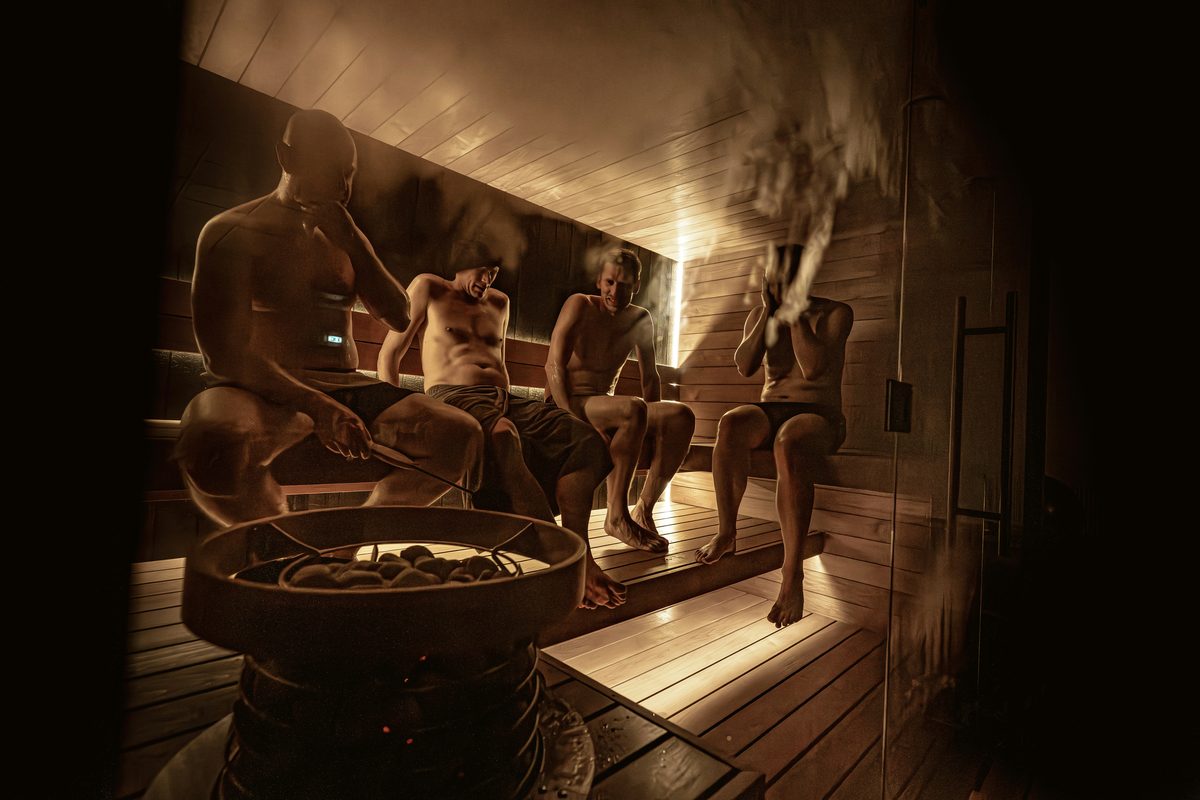
In a traditional sauna, you create steam by pouring water over the hot stones called löyly (pronounced "loo-loo") in Finnish. This is the soul of the sauna experience.
How to Pour Löyly Properly
- 1.Use a ladle and wooden bucket. Never pour directly from a hose or bottle.
- 2.Pour slowly over the stones. A small amount goes a long way start with half a ladle.
- 3.Wait for the steam to rise and fill the room before adding more.
- 4.Never pour water on a cold heater. The stones need to be fully heated first.
- 5.Add a few drops of birch or eucalyptus essence to the water for a traditional scent.
Sauna Bucket and Ladle
Essential for every traditional sauna. Cedar doesn't absorb odors.
Eucalyptus Sauna Essence
A few drops transforms the session. Opens airways, spa-like atmosphere.
The Cool-Down: Why It Matters
The cool-down between rounds is not optional. It's where a significant portion of the benefit happens. The contrast between extreme heat and cold triggers a cascade of physiological responses endorphin release, improved circulation, and the relaxation response that defines the sauna feeling.
Cold Shower
The most accessible option. 30-60 seconds under cold water is enough. Start with cool, not icy, if you're new to it.
Cold Plunge
The traditional Finnish method. A barrel of cold water, a lake, or a cold plunge tub. Immersion at 50-60°F for 30-90 seconds. Intensely uncomfortable. Worth it.
Cool Air
Step outside in winter. Stand in the cool evening air in a towel. Less intense than cold water, but the contrast still works and it's often enough for daily use.
Hydration and Safety
Building a Routine
The research on cardiovascular benefits used sessions of 4-7 times per week. That's an ambitious target but shows that frequency matters. Even 2-3 times per week produces measurable benefits.
The most sustainable routine is one that fits your actual life. For most people, that means 3-4 sessions per week, 2-3 rounds of 15-20 minutes each. Build up from shorter sessions as your heat tolerance improves.
The best time to use a sauna is whenever you'll actually do it consistently. Post-workout is excellent for recovery. Evening sessions (1-2 hours before bed) improve sleep. Morning sessions are energizing. Pick what fits.