
Buying Guides
Best Infrared Sauna of 2026
By Aurec Senenoi · Updated August 15, 2026 · Retail links reviewed August 15, 2026
Infrared cabins can reduce some site work, but they do not share one electrical, delivery, or performance standard. Start with the measured interior, circuit, room clearances, delivery route, warranty, and the documentation behind any EMF or light claim. Then compare the heat format with the traditional experience you would be giving up.
Advertiser Disclosure
Best in 60 seconds
- Best Overall: Sun Home Equinox. Pick if you want full-spectrum infrared in a premium plug-in cabin. Skip if you want traditional rock-and-steam heat.
- Best Red Light + Infrared: Sun Home Eclipse. Pick if you want serious RLT integrated with infrared. Skip if you only want one or the other.
- Compact infrared shortlist: Dynamic Saunas Barcelona. Compare its 36-by-32-inch interior, 120V/15A requirement, delivery route, and current model documents.
- Need a portable format? A steam tent is not an infrared cabin. Use the portable sauna guide to compare that separate category.
Comparison matrix
| Product | Category winner | Type | Capacity | Max temp | Electrical | Project-price check | Best for | Avoid if |
|---|---|---|---|---|---|---|---|---|
| Sun Home Equinox | Best Overall | Premium full-spectrum | 2 | ~165 °F | 120V | $7k-$10k | Daily wellness use | Want löyly |
| Sun Home Eclipse | Best Red Light + Infrared | RLT + infrared | 2 | ~165 °F | 120V | $8k-$11k | Integrated RLT | Only want one |
| Dynamic Barcelona | Compact infrared shortlist | Far-infrared | 1-2 published | Not published on source checked | 120V/15A | Check current seller | Small indoor footprint | Want stones and steam |
How we picked
This is a desk-researched buyer-fit shortlist, not a hands-on or laboratory test. For the non-partner product, we checked the current manufacturer listing and live Amazon page. We removed the Andora purchase path because the exact item was not found, and we moved the SereneLife steam tent out of the infrared product list because it is a different format.
Where a product is part of an editorial collaboration with a brand, we say so above the placement. The category fit has to be defensible on its own. The Sun Home picks below sit in the premium and red-light niches because that is where they actually win, not because of a brand relationship.
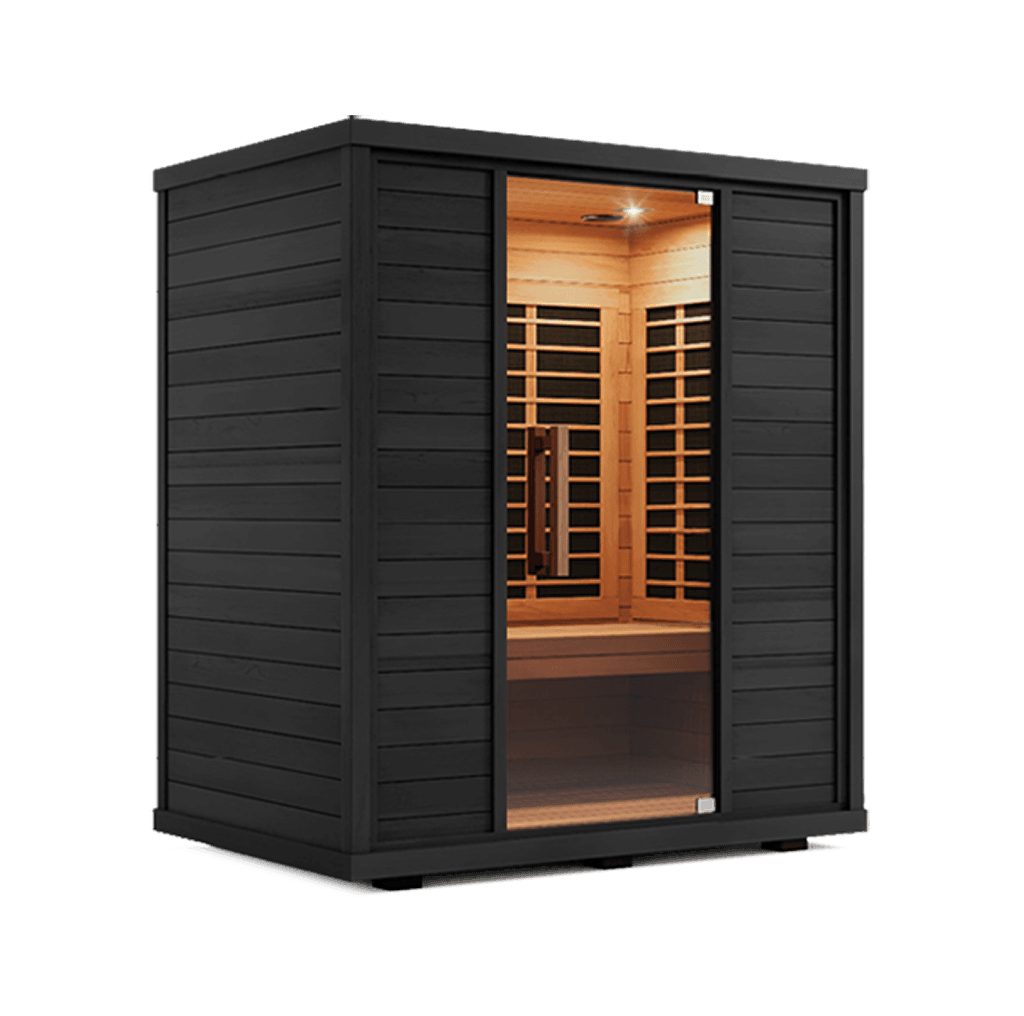
Sun Home Equinox 2-Person Full-Spectrum Infrared
Verdict: The premium infrared cabin where the renderings match what ships. Full-spectrum emitters, real fit and finish, and a plug-in install for a sauna that actually rewards daily use.
Key specs
| Type | Premium indoor infrared cabin |
| Capacity | 2 people |
| Heat source | Full-spectrum infrared (near, mid, far) |
| Max temp | Around 165 °F |
| Electrical | 120V standard outlet |
| Dimensions | Approximately 47 x 45 x 75 in |
| Warranty | Lifetime structural, 5 yr electrical (per manufacturer) |
| Price band | Premium |
Why it won
Full-spectrum emitter sets are still rare at any price, and Sun Home pairs them with a kiln-dried eucalyptus build and a chromotherapy and audio integration that does not feel bolted on. The plug-in install removes the 240V electrician step that kills momentum on most premium sauna purchases.
Tradeoffs
- Premium price tier with no discounting
- Lower max temperature than a traditional sauna
- No rocks, no löyly, no steam
- White-glove delivery scheduling
Owner-complaint patterns
- Heat-up time on the longer side compared to 120V budget cabins
- Some owners want a second tier of bench seating
Installation notes
Standard 120V outlet is sufficient. Plan a level interior space with clearance for the door swing. Two-person carry recommended for the heaviest panel.
BSPuse at checkout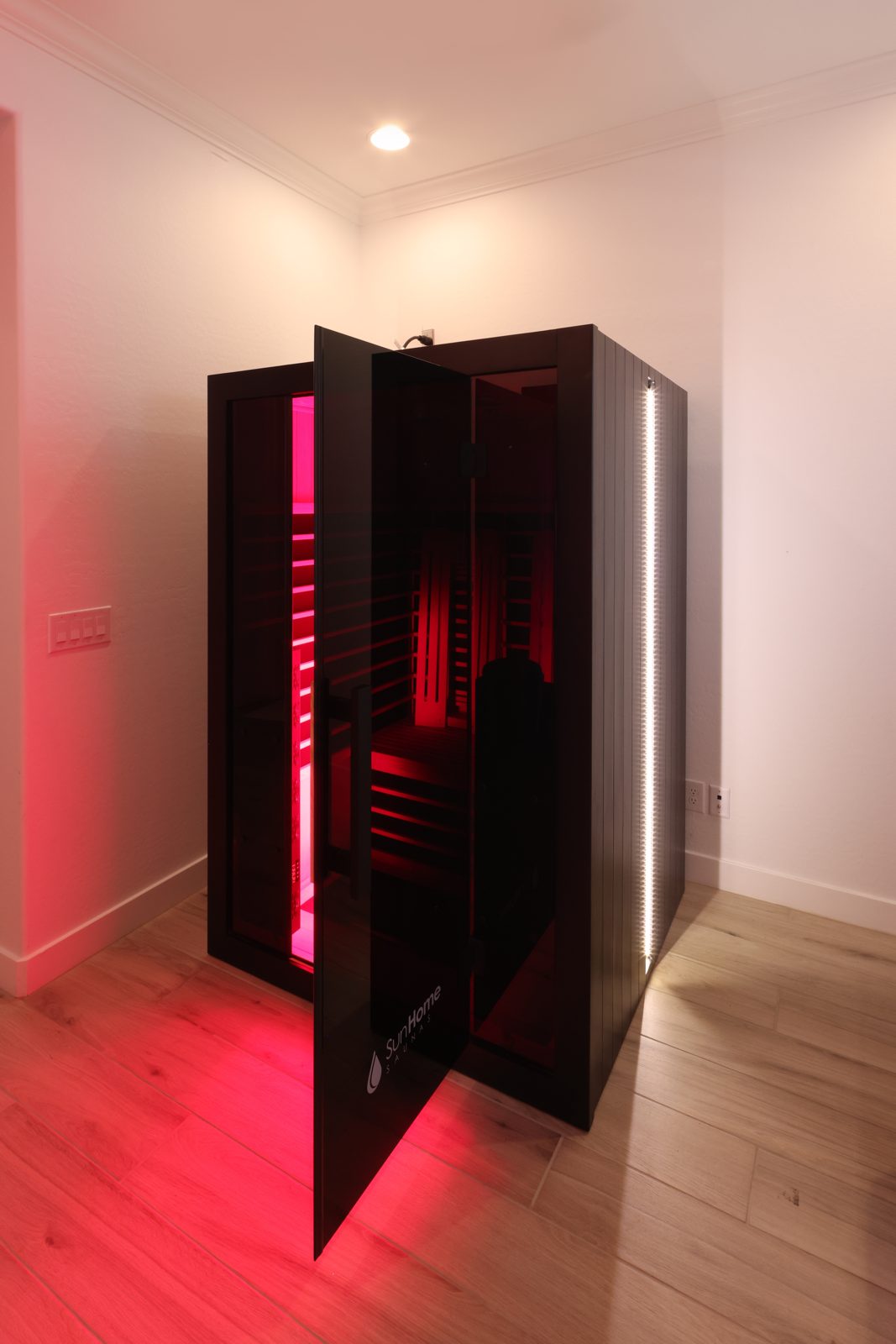
Sun Home Eclipse 2-Person Red Light + Infrared
Verdict: The rare cabin that integrates serious red-light therapy with an infrared sauna instead of strip-LED theater. For buyers who actually want both in one footprint.
Key specs
| Type | Premium indoor red light + infrared |
| Capacity | 2 people |
| Heat source | Full-spectrum infrared + 1,800W red light tower (630-850nm) |
| Max temp | Around 165 °F |
| Electrical | 120V standard outlet |
| Dimensions | Approximately 47 x 45 x 75 in |
| Warranty | Lifetime structural, 5 yr electrical |
| Price band | Premium |
Why it won
Dual-tower red-light panels deliver real irradiance at therapeutic wavelengths, not the 660nm sparkle you see in cheaper builds. The Sun Home app integrates guided sessions so the panel actually gets used.
Tradeoffs
- Premium price tier
- Niche use case (RLT plus infrared combined)
- Higher cost than buying a sauna and an RLT panel separately
- Not a traditional sauna experience
Owner-complaint patterns
- Some buyers underestimate the brightness on the highest setting, eye protection helps
Installation notes
120V plug-in. Plan clearance for the tower-mounted panels. Indoor only.
BSPuse at checkout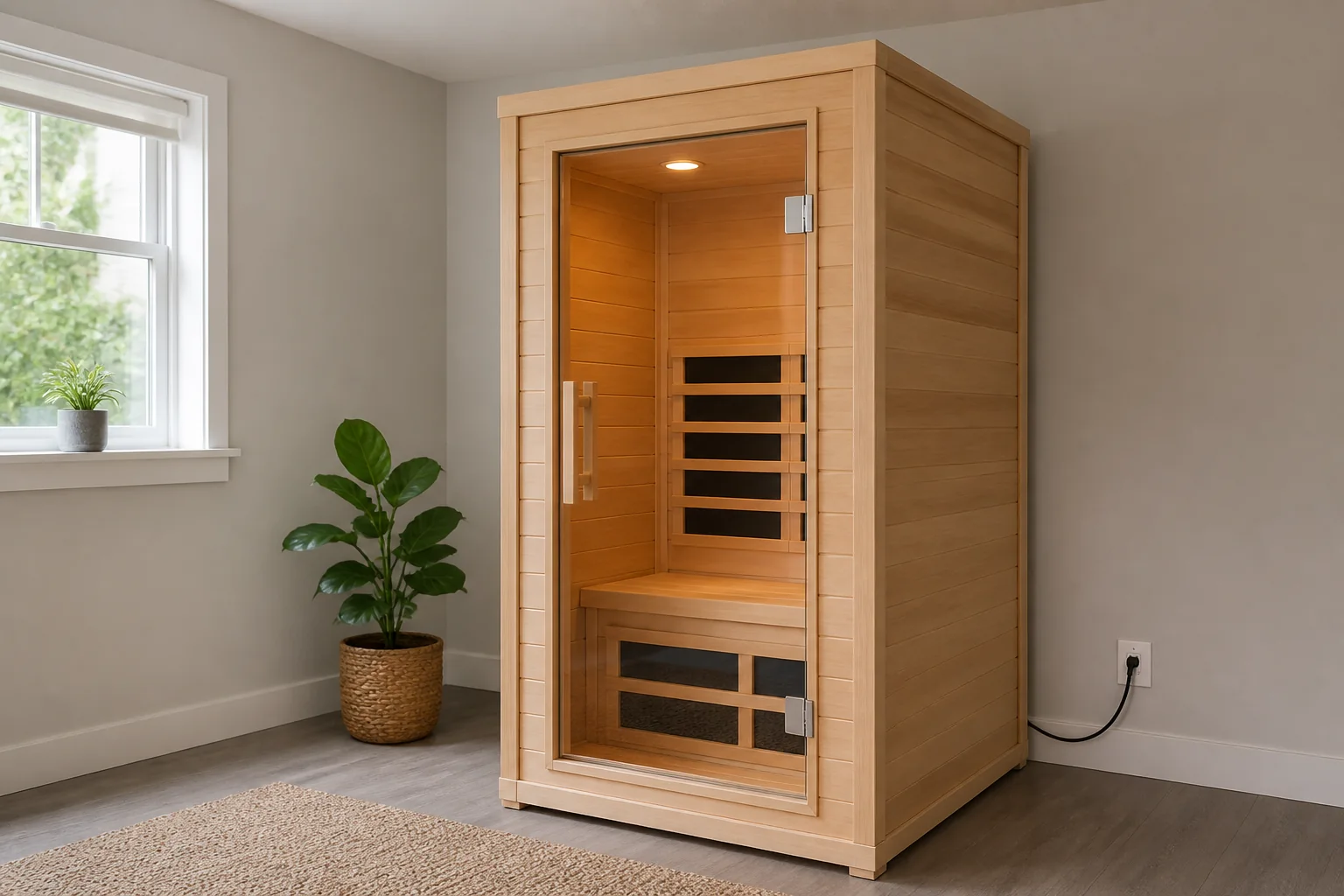
Representative infrared-cabin setup; not the exact Dynamic model.
Dynamic Saunas Barcelona 1-2 Person
Verdict: A compact indoor infrared cabin to compare when the published 36-by-32-inch interior and 120V/15A requirement fit your room and circuit.
Key specs
| Type | Budget indoor infrared |
| Capacity | 1-2 people |
| Heat source | Six carbon infrared panels |
| Electrical | 120V / 15A |
| Dimensions | 39 W x 36 D x 73 H in |
| Price band | Budget |
Why it may fit
The manufacturer publishes the model number, interior and exterior dimensions, weight, electrical requirement, and panelized assembly format needed for a practical fit check.
Tradeoffs
- Infrared format does not provide water-on-stones steam
- Published two-person capacity is tight
- The product page does not document a maximum temperature
Questions to resolve
- Which model revision, manual, warranty, and return terms apply?
- What measured EMF or light specifications support any seller claims?
Installation notes
Confirm the current manual, circuit restrictions, delivery route, panel dimensions, room clearances, and number of people needed for assembly.
What to look for in 2026
Full-spectrum vs far-only emitters
Full-spectrum and far-infrared describe different emitter configurations. They do not, by themselves, prove a health outcome. Compare the model-specific emitter bands, placement, controls, power, test documentation, and intended use.
EMF ratings
A low-EMF label is incomplete without numerical readings and a method. Ask for the measurement distance, frequency range, operating condition, units, equipment, and test source for the exact model.
Wood quality
Wood species is one part of the cabin. Also compare panel construction, adhesives and finishes, ventilation, cleaning instructions, odor sensitivity, service access, and the warranty. Do not treat a species name as proof of durability or performance.
Electrical: 120V vs 240V
Use the selected model manual, not the category label. Confirm voltage, amperage, circuit sharing, receptacle placement, grounding, clearances, and extension-cord restrictions before delivery. If the electrical scope changes the project, compare it with a traditional option before buying. See our infrared vs traditional comparison.
FAQ
Is an infrared sauna worth buying?
It can be when the heat format, usable interior, room, circuit, delivery route, warranty, and total project cost fit how you plan to use it. Buyers who want stones and water-on-stones steam should compare a traditional sauna instead. Do not justify the purchase with an unverified health or savings claim.
How should I evaluate an EMF claim?
Ask for a current model-specific report that states the measurement distance, operating condition, frequency range, units, equipment, and test source. A generic low-EMF label without numerical readings and a method does not support a precise comparison.
Does an infrared sauna need 120V or 240V?
The selected model manual controls. The Dynamic Barcelona source reviewed here lists 120V/15A service, but other cabins differ. Confirm circuit sharing, receptacle placement, grounding, clearances, and extension-cord restrictions before delivery.
Full-spectrum or far-infrared: which should I choose?
Treat those terms as heating-system descriptions, not proof of a health outcome. Compare the published emitter bands, placement, controls, power, test documentation, and how the cabin will actually be used. If a claimed benefit matters to the purchase, ask for the supporting model-specific evidence.
How long should an infrared sauna session be?
Follow the current product instructions and any advice from your clinician. Session limits depend on the equipment, operating conditions, user, medications, and health status. This buying guide does not provide a universal medical-use schedule.
How is infrared different from a traditional sauna?
Infrared cabins use emitters and do not provide water-on-stones steam. Traditional saunas use a purpose-built room heater and stones; whether water may be used depends on the heater instructions. Temperature, electrical load, ventilation, and operating guidance vary by exact product.
Is daily infrared sauna use safe?
We cannot determine that for an individual. Follow the product's safety instructions and ask a qualified clinician about heat exposure if you have a health condition, are pregnant, take medication that affects heat response, or have symptoms during use.
What wood is best for an infrared sauna?
There is no single best species for every cabin. Compare the manufacturer's construction details, adhesives and finishes, ventilation, maintenance instructions, odor sensitivity, warranty, and replacement support. Wood species alone does not establish durability or performance.
Can an infrared sauna be installed outdoors?
Only when the exact model is listed and warranted for the intended outdoor exposure. A roof or covered porch does not convert an indoor-rated electrical appliance into an outdoor unit. Confirm weather rating, support surface, drainage, clearances, power, and warranty in writing.
Does infrared sauna use improve recovery?
This page does not make a medical or performance claim. Research on heat exposure does not prove that every infrared product will produce a specific result for an individual. Evaluate the purchase on documented product fit and discuss health goals with a qualified clinician.